|
| Author Mark Fisher outside the Fringe Office |
THERE was an interesting exchange of Twitter messages this week between me and comedians Elise Harris and Andrew J Lederer. The 140 characters of Twitter are not ideal for expressing the subtleties of a complex debate, so I hope Elise and Andrew will add their own comments at the end of this post – in the meantime, I’ll try and do justice to what they said, the approximate order in which they said it and what I was thinking at the time.
It started with this tweet from Elise:
Wondering whether it’s worth going in the main book with my Edinburgh show this year. Advice from anyone who’s done the Fringe without it?
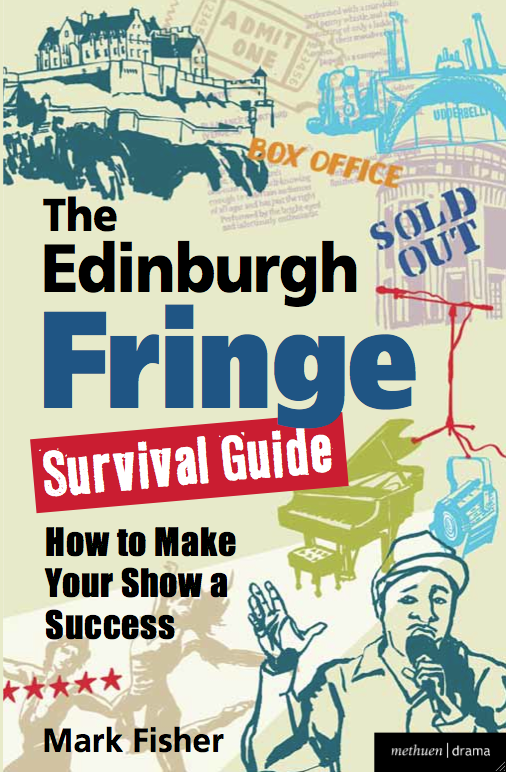
By “book”, she was referring to the 280-page Fringe Programme, traditionally regarded as the bible for fringegoers and the index of everything that’s on in the world’s biggest arts festival. Eying my chance to gain a reader of The Edinburgh Fringe Survival Guide(yes, dear reader, I’m that shameless), I replied:
@eliseharris All advice is not to go it alone unless you have a very particular reason. See my book: edinburghfringesurvivalguide.com #edfringe #edfest
To which Elise said:
@MarkFFisher well the book is expensive and no longer seems worth it at all. Doesn’t seem to bring people in, even.
And I said:
@eliseharris It’s your choice, but signing up for @edfringe gives you more than just programme entry. It’s discussed quite a lot in my book.
What I had in mind were two stories related in my book about performers who had gone ahead without being in the Fringe Programme. One told me he’d had a disastrous time and had returned for a second year determined to do things right; the other managed to grasp victory from the jaws of defeat, but only with considerable professional support and a great show (and even he said he wouldn’t do it the same way again). My general feeling is you have competition enough without making yourself invisible by avoiding the Fringe Programme.
I was also thinking about what else you get for your payment to the Edinburgh Festival Fringe Society. The entry in the Fringe Programme is the most visible benefit – online as well as in print – but what you’re paying for is also a way to sell your tickets through a central box office as well as an extensive set of support services in areas such as press and marketing and post-Fringe planning.
Elise said:
@MarkFFisher if I had the spare funds I would but it’s looking increasingly tight and I won’t ever see that money again.
At this point, Andrew joined in with these three tweets:
@eliseharris @MarkFFisher Don’t know what it says in your book Mark, but I do know for many, the cost of “official” entry is a useless waste
@eliseharris @MarkFFisher The Fringe Society “extras” amount in a practical sense to nothing unless you are a neophyte.
@eliseharris @MarkFFisher Last note: U gotta be in SOME book & it’s gotta be one people use, either the main, the free or the big venue one.
My comment about this was:
@ajlondemand @eliseharris Andrew = old hand so take him seriously, but 2500 companies choose @edfringe programme so he’s in a minority
Being in a minority doesn’t mean he’s wrong, of course, but anyone contemplating going it alone would be sensible to consider the possibility that there is wisdom in this particular crowd. To this, Andrew replied:
@MarkFFisher @eliseharris @edfringe And many/most of those 2500 should be. I agree.
I added:
@eliseharris @ajlondemand Do you need reviewers, agents, promoters, judges and auds to see your show? If so, how will they know it’s on?
What I hadn’t realised at this point was that Elise is planning to perform in one of the free festivals. This does put a different perspective on things. For a start, if your show is free (and unticketed), you have no need of a box office. I’m guessing that’s what Elise means when says she “won’t ever see that money again” – she would be paying for a box office that would not pay her anything in return.
The question then is how valuable the Fringe Society’s other services are to her. There is no fixed answer to this question: it depends on what she wants to get out of her run on the Fringe. Only she can answer that.
But for a free show, it’s quite possible that the most effective use of funds is to do as Andrew suggests: make sure your show is listed in your venue’s programme and concentrate on flyering audiences on the street. Andrew said this:
@MarkFFisher @eliseharris She’s in the Free Fringe. Audiences come directly from the FF programme. & Flyering. A press release may get press
@MarkFFisher @eliseharris Likewise, a listing in the Society programme may not. Judges are irrelevant to most shows.
Equally, though, Elise herself then made the point that being in the Fringe Programme had the knock-on benefit of getting you included in, for example, newspaper listings:
@ajlondemand @MarkFFisher yes you need to be in a book of some sort. Though need to be in big book for most listings. Might have to think.
As for my point about all the various people – “reviewers, agents, promoters, judges” – who may be using the Fringe Programme in addition to regular audiences, she said:
@ajlondemand @MarkFFisher yes Free Fringe best for getting people in, and reviewers tend to be useless anyway. Official listings the problem
I’d be interested to know what she means by reviewers being useless – not because I am one (I know how useless I am), but because even in the past few days, I’ve been finding reviewers very useful as a way of promoting my book. Putting their nice comments on my website here strikes me as a very effective way of persuading people not only to buy the book but also to take me seriously in anything I might do in future. The value of reviews on the Fringe is partially to do with attracting audiences and partially, for those that want it, to do with raising your profile, persuading funders, getting gigs, or whatever, after the festival.
All of which brought us to a final volley of comments from Andrew (and one from Elise) which, I think, are worthy of further discussion:
@eliseharris @MarkFFisher Over time, as the Free becomes an ever larger component, the press will b forced to list its shows wout Fringe reg
@eliseharris @MarkFFisher In the short term, I’ve found that if you’re in a good free venue at a good time, you’ll get an audience.
@eliseharris @MarkFFisher And it helps if you have a good show. ‘Specially now, w/Twitter, etc, people spread word quickly if you do.
@ajlondemand @MarkFFisher though a bad venue at a bad time and nothing will help!
You know what? I think my comments to @eliseharris & @markffisher re @edfringe would be helpful to people. So, look. #edfringe
I’m interested to hear what other people have to say about this. One thing I would emphasise, however, is that Andrew’s perspective is likely to make most sense a) if you are performing in the PBH Free Fringe or the Laughing Horse Free Festival and b) if your only concern is getting audiences. The picture changes quite dramatically if you are performing anywhere else or if you have any additional reason for appearing on the Fringe, such as being spotted by an agent, getting post-Fringe gigs and other professional concerns. The Edinburgh Fringe Survival Guidegoes into this in much more detail.